|
DVID
|
7000017 |
|
VISID
|
TVIS43000054 |
|
Chromosome
|
chr12 |
|
GRCh38 Location
|
69690384 |
|
Disease
|
Carcinoma, merkel cell |
|
Sample
|
Cell line |
|
Virus Reference Genome
|
EU375803 |
|
Target Gene
|
BEST3 |
Literature Information
|
PubMed PMID
|
30873613
|
|
Year
|
2019 Aug 15;145(4):1020-1032 |
|
Journal
|
International journal of cancer |
|
Title
|
Characterization of six Merkel cell polyomavirus-positive Merkel cell carcinoma cell lines: Integration pattern suggest that large T antigen truncating events occur before or during integration. |
|
Author
|
Schrama D,Sarosi EM,Adam C,Ritter C,Kaemmerer U,Klopocki E,Konig EM,Utikal J,Becker JC,Houben R |
|
Evidence
|
Merkel cell carcinoma (MCC), an aggressive neuroendocrine skin tumor, is a polyomavirus-induced human cancer. To study the causal relationship of MCC carcinogenesis with the integrated Merkel cell polyomavirus (MCPyV) in detail, well-characterized MCC cell lines are needed. Consequently, in the current study, we established and characterized six MCPyV-positive MCC cell lines. Microarray-based comparative genomic hybridization revealed a stable genome carrying only a limited number of chromosomal gains and deletions. All cell lines expressed MCC markers Keratin-20 and neuron-specific enolase as well as truncated MCPyV-encoded large T antigen (LT). For five cell lines, we were able to identify the MCPyV-integration sites in introns of different genes. The LT-truncating stop codon mutations and integration sites were affirmed in the respective clinical patient samples. Inverse PCR suggested that three of the cell lines contained MCPyV genomes as concatemers. This notion was confirmed for the two cell lines with known integration sites. Importantly, our observation of distinct stop codon mutations in cell lines with concatemeric MCPyV integration indicates that these LT-truncating mutations occur before integration. In summary, we provide the detailed characterization of six MCPyV-positive MCC cell lines, which are likely to serve as valuable tools in future MCC research.
|
|
|
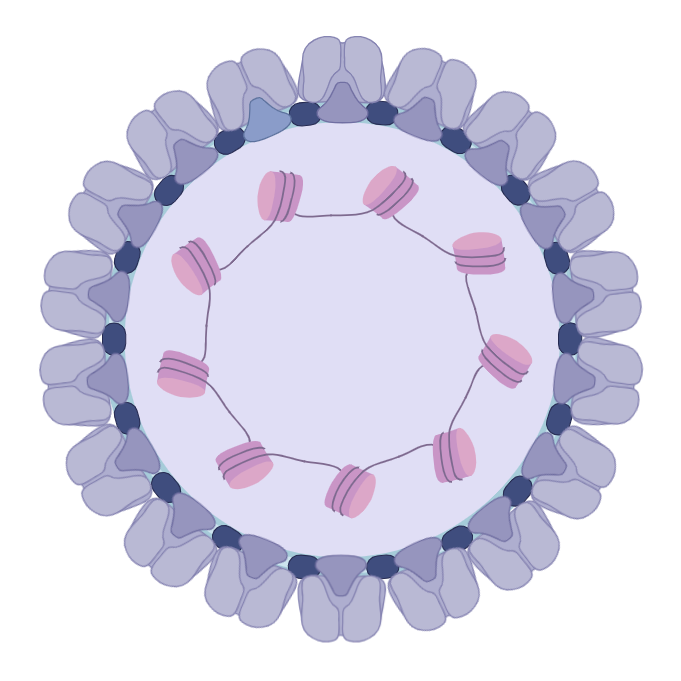 MCV VIS Detail Information
