|
Basic Characteristics of Mutations
|
|
Mutation Site
|
A437T |
|
Mutation Site Sentence
|
Three non-synonymous mutations (E2 S248F and NSP3 A437T and L451F) were present in our sequences, which were also identified in sequences of the Caribbean lineage and in one Philippine sequence. |
|
Mutation Level
|
Amino acid level |
|
Mutation Type
|
Nonsynonymous substitution |
|
Gene/Protein/Region
|
nsP3 |
|
Standardized Encoding Gene
|
nsP3
|
|
Genotype/Subtype
|
Asian |
|
Viral Reference
|
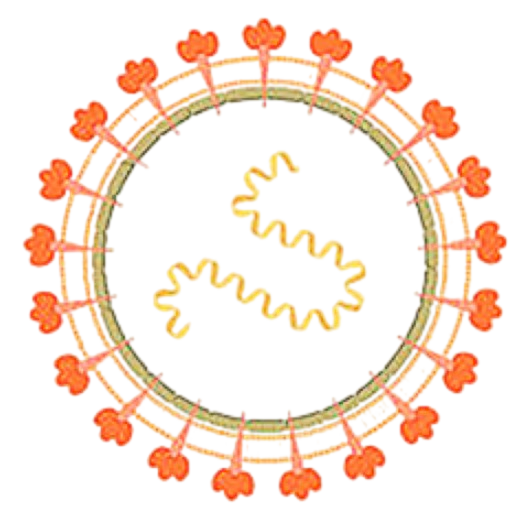
Figure 1
|
|
Functional Impact and Mechanisms
|
|
Disease
|
Chikungunya Fever
|
|
Immune
|
- |
|
Target Gene
|
-
|
|
Clinical and Epidemiological Correlations
|
|
Clinical Information
|
- |
|
Treatment
|
- |
|
Location
|
Mexico |
|
Literature Information
|
|
PMID
|
35062275
|
|
Title
|
Genetic Diversity and Spatiotemporal Dynamics of Chikungunya Infections in Mexico during the Outbreak of 2014-2016
|
|
Author
|
Rodriguez-Aguilar ED,Martinez-Barnetche J,Gonzalez-Bonilla CR,Tellez-Sosa JM,Argotte-Ramos R,Rodriguez MH
|
|
Journal
|
Viruses
|
|
Journal Info
|
2021 Dec 31;14(1):70
|
|
Abstract
|
Chikungunya virus (CHIKV) is an alphavirus transmitted by Aedes mosquitoes, which causes Chikungunya fever. Three CHIKV genotypes have been identified: West African, East-Central-South African and Asian. In 2014, CHIKV was detected for the first time in Mexico, accumulating 13,569 confirmed cases in the following three years. Studies on the molecular diversification of CHIKV in Mexico focused on limited geographic regions or investigated only one structural gene of the virus. To describe the dynamics of this outbreak, we analyzed 309 serum samples from CHIKV acute clinical cases from 15 Mexican states. Partial NSP3, E1, and E2 genes were sequenced, mutations were identified, and their genetic variability was estimated. The evolutionary relationship with CHIKV sequences sampled globally were analyzed. Our sequences grouped with the Asian genotype within the Caribbean lineage, suggesting that the Asian was the only circulating genotype during the outbreak. Three non-synonymous mutations (E2 S248F and NSP3 A437T and L451F) were present in our sequences, which were also identified in sequences of the Caribbean lineage and in one Philippine sequence. Based on the phylogeographic analysis, the viral spread was reconstructed, suggesting that after the introduction through the Mexican southern border (Chiapas), CHIKV dispersed to neighboring states before reaching the center and north of the country through the Pacific Ocean states and Quintana Roo. This is the first viral phylogeographic reconstruction in Mexico characterizing the CHIKV outbreak across the country.
|
|
Sequence Data
|
-
|
|
|