|
Basic Characteristics of Mutations
|
|
Mutation Site
|
G249R |
|
Mutation Site Sentence
|
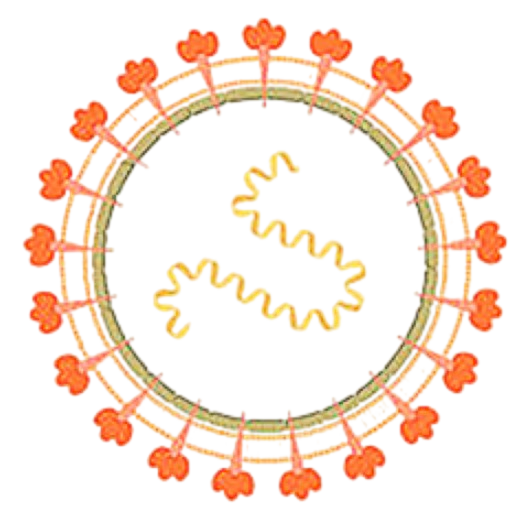
The three fixed mutations in the E2 glycoprotein detected in Ae. aegypti (I217V and G249R) and Ae. albopictus (G82R) were located on the surface of the virion without any obvious interaction with the position E1-226 (Supplementary Fig. 2). |
|
Mutation Level
|
Amino acid level |
|
Mutation Type
|
Nonsynonymous substitution |
|
Gene/Protein/Region
|
E2 |
|
Standardized Encoding Gene
|
E2
|
|
Genotype/Subtype
|
- |
|
Viral Reference
|
-
|
|
Functional Impact and Mechanisms
|
|
Disease
|
Chikungunya Fever
|
|
Immune
|
- |
|
Target Gene
|
-
|
|
Clinical and Epidemiological Correlations
|
|
Clinical Information
|
- |
|
Treatment
|
- |
|
Location
|
- |
|
Literature Information
|
|
PMID
|
27383735
|
|
Title
|
Importance of mosquito "quasispecies" in selecting an epidemic arthropod-borne virus
|
|
Author
|
Vazeille M,Zouache K,Vega-Rua A,Thiberge JM,Caro V,Yebakima A,Mousson L,Piorkowski G,Dauga C,Vaney MC,Manni M,Gasperi G,de Lamballerie X,Failloux AB
|
|
Journal
|
Scientific reports
|
|
Journal Info
|
2016 Jul 7;6:29564
|
|
Abstract
|
Most arthropod-borne viruses (arboviruses), perpetuated by alternation between a vertebrate host and an insect vector, are likely to emerge through minor genetic changes enabling the virus to adapt to new hosts. In the past decade, chikungunya virus (CHIKV; Alphavirus, Togaviridae) has emerged on La Reunion Island following the selection of a unique substitution in the CHIKV E1 envelope glycoprotein (E1-A226V) of an East-Central-South African (ECSA) genotype conferring a higher transmission rate by the mosquito Aedes albopictus. Assumed to have occurred independently on at least four separate occasions, this evolutionary convergence was suspected to be responsible for CHIKV worldwide expansion. However, assumptions on CHIKV emergence were mainly based on viral genetic changes and the role of the mosquito population quasispecies remained unexplored. Here we show that the nature of the vector population is pivotal in selecting the epidemic CHIKV. We demonstrate using microsatellites mosquito genotyping that Ae. albopictus populations are genetically differentiated, contributing to explain their differential ability to select the E1-226V mutation. Aedes albopictus, newly introduced in Congo coinciding with the first CHIKV outbreak, was not able to select the substitution E1-A226V nor to preferentially transmit a CHIKV clone harboring the E1-226V as did Ae. albopictus from La Reunion.
|
|
Sequence Data
|
-
|
|
|