|
Basic Characteristics of Mutations
|
|
Mutation Site
|
T124A |
|
Mutation Site Sentence
|
Thereafter, seven mutants of Gc ((T1045I, A1046V, G1158E, A1451T, H1527Y, M1597I, and K1652R), one mutant of Gn (I778T) and eight mutant models in NP (R15K, T124A/S, G125N, H195R, I246V, S301G and V436I) were generated, as NP protein with two amino acid variations were recorded at 124 position; therefore, effect of both variations were examined individually. |
|
Mutation Level
|
Amino acid level |
|
Mutation Type
|
Nonsynonymous substitution |
|
Gene/Protein/Region
|
NP |
|
Standardized Encoding Gene
|
S
|
|
Genotype/Subtype
|
- |
|
Viral Reference
|
NP_950235.1;NP_950237.1
|
|
Functional Impact and Mechanisms
|
|
Disease
|
Hemorrhagic Fever, Crimean
|
|
Immune
|
- |
|
Target Gene
|
-
|
|
Clinical and Epidemiological Correlations
|
|
Clinical Information
|
- |
|
Treatment
|
- |
|
Location
|
- |
|
Literature Information
|
|
PMID
|
38054375
|
|
Title
|
Analysis of highly frequent point mutations in glycoprotein C, glycoprotein N, and nucleoprotein of CCHFV
|
|
Author
|
Kaushal N,Baranwal M
|
|
Journal
|
Biotechnology and applied biochemistry
|
|
Journal Info
|
2024 Apr;71(2):280-294
|
|
Abstract
|
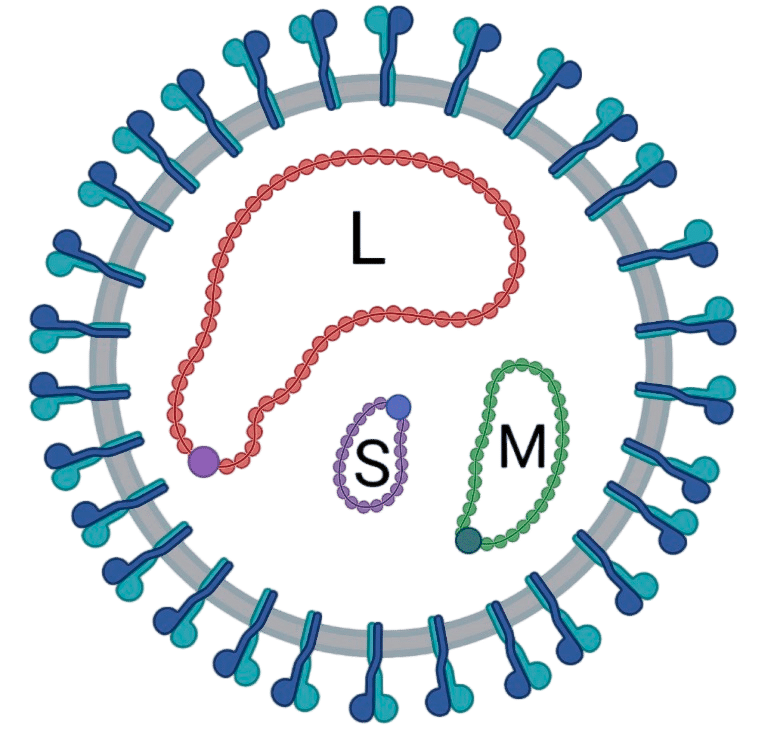
Crimean-Congo hemorrhagic fever virus (CCHFV) is classified among top 10 priority pathogens by World Health Organization. CCHFV belongs to Bunyaviridae family and negative sense ssRNA genome composed of three RNA segments: L, M, and S. RNA viruses show higher mutation rate as compared to DNA viruses. To gain deeper understanding of impact of point mutations in CCHFV M and S segment, mutation profiling, homology modeling, and molecular dynamic (MD) simulation were performed. Structural glycoproteins (glycoprotein C [Gc] and glycoprotein N [Gn]) of CCHFV are important for host-virus interaction and genome packaging, whereas CCHFV nucleoprotein (NP) is crucial for viral replication. Hence, current study is focused on evaluation of eight mutations in structural glycoproteins (Gc: 7 and Gn: 1) of M segment and seven mutations in NP of S segment. All these mutations were highly frequent, with mutation frequency between 0.81 and 1.0 and found to be persistent in the recent strains of CCHFV. Solubility analysis predicted that selected point mutations reduce solubility of Gc protein and increase solubility of Gn and NP proteins. MD simulation study deciphered that A1046V and G1158E in Gc protein, I778T in Gn protein, and H195R in NP protein displayed large deviation and fluctuation, and affected intramolecular interactions. In conclusion, we observed that point mutations could impact structure, stability, and host-virus interaction of protein, and might lead to evolution of new strains for better survival and drug resistance.
|
|
Sequence Data
|
-
|
|
|