Gene Information
|
Gene Name
|
KPNA2 |
|
Gene ID
|
3838
|
|
Gene Full Name
|
karyopherin subunit alpha 2 |
|
Gene Alias
|
IPOA1|PTAC58|QIP2|RCH1|SRP1-alpha|SRP1alpha |
|
Transcripts
|
ENSG00000182481
|
|
Virus
|
ZIKV |
|
Gene Type
|
protein-coding |
|
HPA Location Info
|
Nucleoplasm;Cytosol; 
|
|
Membrane Info
|
Plasma proteins, Predicted intracellular proteins, Transporters |
|
Uniport_ID
|
P52292
|
|
HGNC ID
|
HGNC:6395
|
|
OMIM ID
|
600685 |
|
Summary
|
The import of proteins into the nucleus is a process that involves at least 2 steps. The first is an energy-independent docking of the protein to the nuclear envelope and the second is an energy-dependent translocation through the nuclear pore complex. Imported proteins require a nuclear localization sequence (NLS) which generally consists of a short region of basic amino acids or 2 such regions spaced about 10 amino acids apart. Proteins involved in the first step of nuclear import have been identified in different systems. These include the Xenopus protein importin and its yeast homolog, SRP1 (a suppressor of certain temperature-sensitive mutations of RNA polymerase I in Saccharomyces cerevisiae), which bind to the NLS. KPNA2 protein interacts with the NLSs of DNA helicase Q1 and SV40 T antigen and may be involved in the nuclear transport of proteins. KPNA2 also may play a role in V(D)J recombination. Alternative splicing results in multiple transcript variants. [provided by RefSeq, Feb 2016] |
Target gene [KPNA2] related to virus gene/protein/region 
Mutation Table: if previous studies reported that target gene was related to virus gene/region/protein, the information in this literature was listed in this section
| ID |
PMID |
Mutation |
Gene/Protein/Region |
Encoding Gene/Protein |
Disease |
Description |
Detail |
| 1 |
32924767 |
T100A |
NS2A
|
NS2A
|
Cell line
|
G
R
T
|
View |
Target gene [KPNA2] related to Omics data
| Data ID |
Experiment type |
Sample number |
Platform |
|
GSE198542
|
RNA-seq |
12 |
Illumina NextSeq 500 (Homo sapiens) |
|
GSE176428
|
RNA-seq |
8 |
Illumina MiSeq (Homo sapiens) |
|
GSE78711
|
RNA-seq |
8 |
Illumina MiSeq (Homo sapiens);Illumina NextSeq 500 (Homo sapiens) |
|
GSE178621
|
RNA-seq |
28 |
Illumina NovaSeq 6000 (Homo sapiens) |
|
C GSE161783
|
Chip-seq;RNA-seq;csRNA-seq |
51 |
Illumina NextSeq 500 (Homo sapiens);Illumina HiSeq 4000 (Homo sapiens);Illumina NovaSeq 6000 (Homo sapiens) |
|
E GSE105884
|
RNA-seq |
60 |
Illumina HiSeq 2500 (Homo sapiens) |
|
GSE209698
|
RNA-seq |
16 |
Illumina NextSeq 500 (Homo sapiens) |
|
GSE123835
|
RNA-seq |
6 |
Illumina HiSeq 2500 (Homo sapiens) |
|
GSE160201
|
RNA-seq |
16 |
Illumina NextSeq 500 (Homo sapiens) |
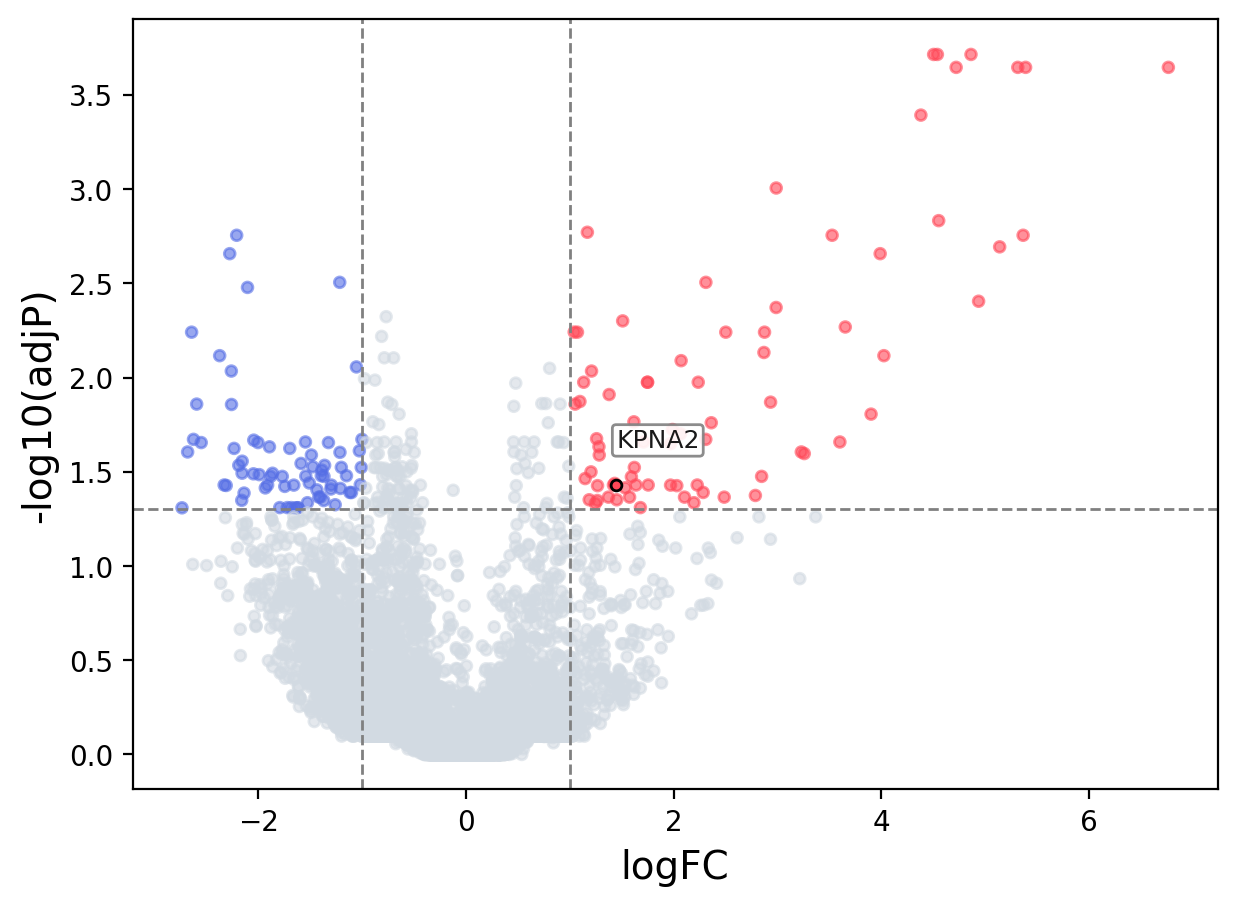
When the query gene is differentially changed in the dataset, a volcano/bar plot will be displayed.
> Dataset: GSE105884 - KPNA2 expression across samples
|
Volcano Plot
|
Bar Plot
|
|
|
 ZIKV Target gene Detail Information
